
Blown-In Attic Insulation in La Puente, CA
Blown-in attic insulation – also called loose-fill insulation – is a method where we use a hose-fed blowing machine to fill your attic floor with small fiber or cellulose particles, covering joists, irregular framing, and awkward corners that batt insulation never reaches cleanly. Most La Puente homes built before 2000 have attic floors that are either under-insulated or missing coverage in key spots, and our Attic Insulation services using blown-in material corrects both problems in a single visit. If your home’s second floor runs noticeably warmer than the first, or your utility bills climb every summer despite a functioning AC, there’s a good chance the attic is where the problem starts.
At Topside Attic Insulation La Puente, we’ve been following The Haven Standard since 2016, which means we will not blow a single bag of material until the attic floor has been air-sealed – every top plate gap, can light, and pipe penetration closed first. That’s not an upsell we offer after the fact; it’s the first step on every job, because insulation that sits over unsealed air leaks performs well below its rated R-value. If you want to talk through what your attic actually needs, call us at (626) 509-3237 – a live person answers, not a voicemail queue.
This page covers the full process, what it costs in the La Puente market, and the questions we hear most often. For broader context on attic work, our Attic Insulation in La Puente page covers the complete service line.
When You Need Blown-In Attic Insulation
Blown-in insulation is the right fit in several specific situations. Here’s what we typically find when a La Puente homeowner calls us:
- Existing insulation is below R-30. California’s Title 24 energy code targets R-38 for attics in Climate Zone 9, which covers most of the San Gabriel Valley including La Puente. If what’s up there is thin, compressed, or covered in rodent debris, it’s not doing the job – and topping up with blown-in material is usually more cost-effective than a full tear-out.
- The second floor is 8-12 degrees warmer than the first in summer. La Puente regularly sees July and August highs above 95°F, and an under-insulated attic can turn that into 140°F of radiant heat sitting directly above your living space. Blown-in material adds depth quickly across the full floor area, including the tight eave bays near the roofline that batts can’t reach.
- The attic has irregular or non-standard joist spacing. A lot of the ranch-style homes in La Puente’s older neighborhoods – particularly in the blocks east of Hacienda Boulevard and around Workman Mill Road – were framed before standard 16-inch-on-center spacing was universal. Blown-in material conforms to whatever framing it finds, batts don’t.
- You’ve had rodent activity and the existing insulation was removed. After an attic cleaning and rodent-proofing job, blown-in material is the most practical way to restore coverage quickly and evenly. We see this regularly in homes near the older commercial corridors on Valley Boulevard.
- Your energy bills have been creeping up without an obvious cause. A blower-door test – a pressurization reading that shows, in one number, how much conditioned air your building envelope is losing – often points directly to the attic as the biggest leak point. In La Puente homes from the 1960s and 1970s, we frequently read pre-sealing numbers above 3,500 CFM50.
- You’re preparing for a home sale or a Title 24 compliance check. An attic at or above R-38 is a documented upgrade that appraisers and buyers notice, and it’s one of the few home improvements with a clear, measurable before-and-after metric.
Our Blown-In Attic Insulation Process
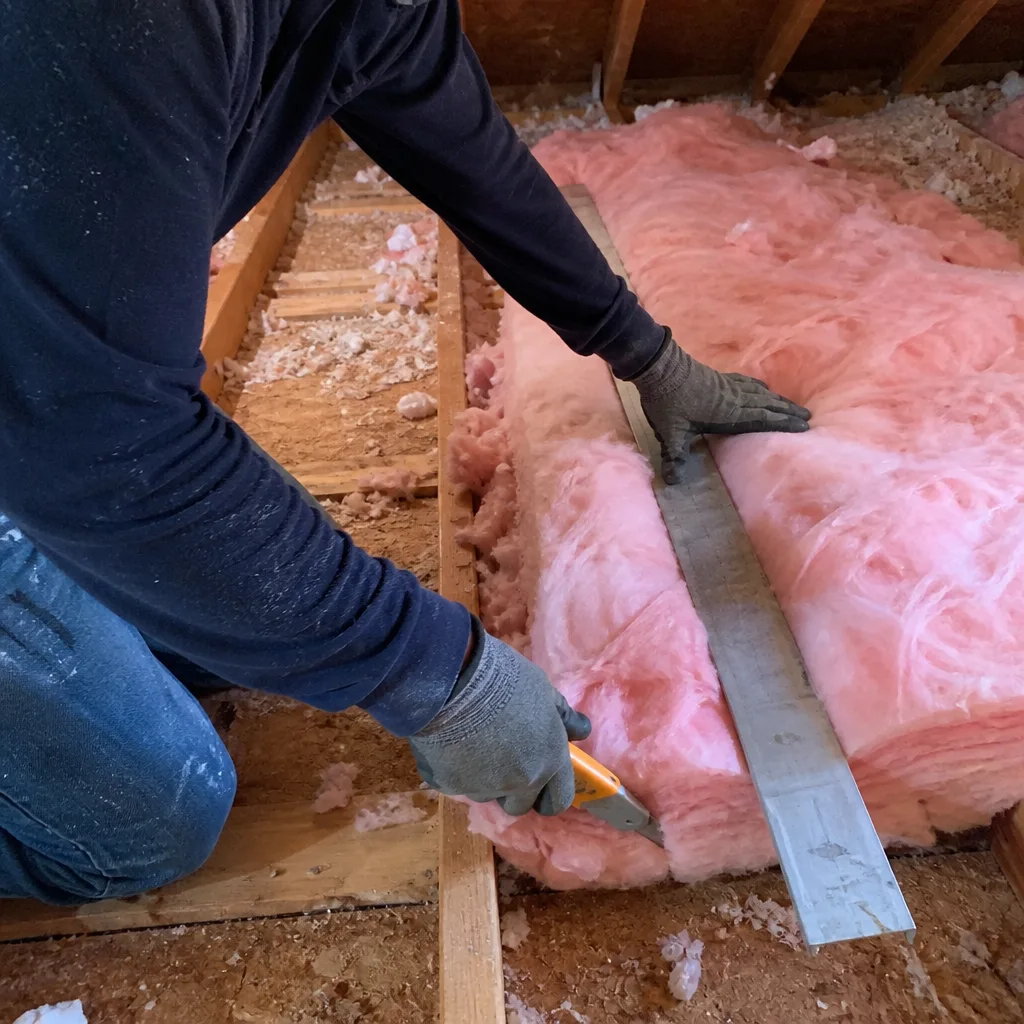
The order of operations matters more than most homeowners realize. Here’s exactly what happens from the time we arrive at your La Puente home to the time we hand you the job documentation.
- Pre-job assessment and written price. Before anyone opens a bag or fires up the blower machine, we measure the attic’s square footage, check the existing insulation depth with a probe, and identify every air-leak point visible from the attic floor. You receive a flat written price and a written scope – Under Haven Standard Clause 1, no work starts without both in your hands first. This is not a verbal estimate subject to revision; it’s the number.
- Air sealing of the attic floor. We seal every top plate gap with two-part spray foam, address recessed can lights with UL-rated covers and foam, and close pipe and wire penetrations that run from the living space into the attic. In a typical La Puente home from the 1970s, this step might address 60 to 80 individual penetrations before we touch any insulation. This is the step most contractors skip or treat as optional; we treat it as the whole point.
- Blower-door test – before reading. On applicable jobs, we run a blower-door test before the insulation goes in. This gives us a baseline CFM50 number. A reading of, say, 4,100 CFM50 before sealing is a concrete data point, not an estimate of how leaky the home feels.
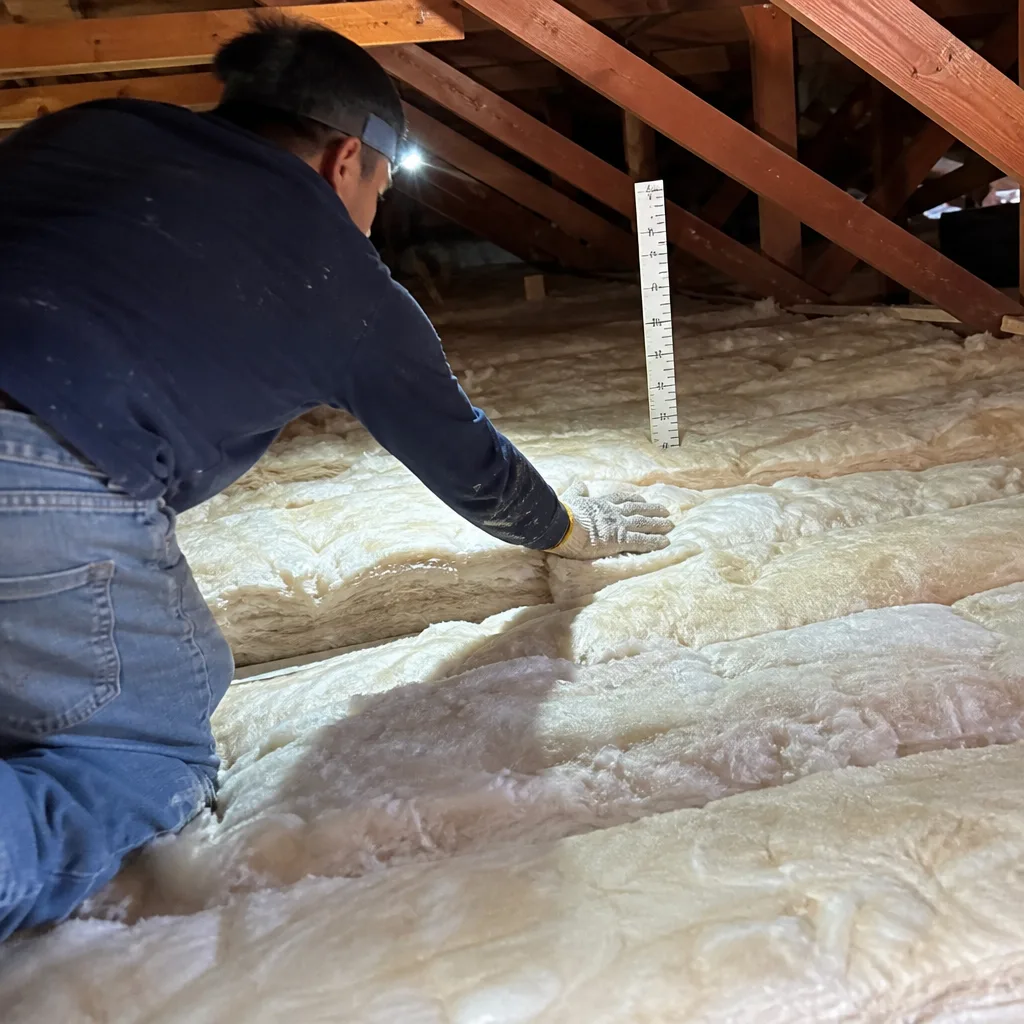
- Installation of blown-in insulation. We use a truck-mounted or trailer-mounted blower machine and fill the attic floor to the depth required to reach your target R-value – typically R-38 to R-49 for La Puente’s climate zone. Material is drawn from Owens Corning or Knauf product lines depending on what the specific job calls for; we’re not locked to one supplier. Depth rulers (measuring baffles) are installed before blowing starts so the crew can confirm coverage depth at multiple points across the floor.
- Blower-door test – after reading and photo record. After the material settles and the equipment is cleared, we run the blower-door test again. The before and after numbers go into your job record. A post-seal reading of 2,050 CFM50 against a baseline of 4,100 is the kind of documented result that tells you what actually changed – not a statement about how well we think the job went. Every job also closes with a Documented Photo Record: photos of the pre-job attic condition, the air-sealing work, the insulation depth at multiple points, and the finished floor.
- Cleanup and written warranty delivery. We clear any debris from the install, restore your attic hatch area, and hand you the written warranty before we leave. The 365-Day Done Right Promise covers the completed work: if something isn’t right within that period, we make it right – no paperwork chase, no charge.
Blown-In Attic Insulation Pricing in La Puente
Blown-in attic insulation in La Puente typically runs between $1.20 and $2.80 per square foot for the insulation itself, depending on material type, current attic depth, and target R-value - see How Much Does Attic Insulation Cost? (2026 Price Guide) - La Puente, CA for full details. For a 1,200 square-foot attic – a common footprint in the single-story ranch homes throughout La Puente’s residential neighborhoods – that puts the insulation portion in the range of $1,440 to $3,360. Air sealing, which we complete before any insulation goes in, is priced separately and typically adds $400 to $900 depending on the number of penetrations and condition of the existing top plates.
| Scope of Work | Typical Range (La Puente Market) |
|---|---|
| Blown-in insulation only (to R-38), 1,000-1,400 sq ft attic | $1,200 – $2,800 |
| Air sealing + blown-in insulation (combined), same size | $1,800 – $3,800 |
| Insulation removal + air sealing + blown-in replacement | $2,800 – $5,500 |
| Top-up only (existing insulation present, adding depth to R-38) | $600 – $1,400 |
What moves the number up: existing insulation that needs removal before new material can go in, a high penetration count requiring extended air-sealing time, attic access points that require a small-duct blower setup rather than a standard hose run, and jobs targeting R-49 rather than R-38. What keeps the number lower: a clean attic with no debris, a simple rectangular floor plan, and existing blocking around the eave bays already in place.
Under The Haven Standard, every quoted price is flat and written before any work starts. There are no change orders issued mid-job unless you explicitly request a scope change. We also offer a Free Second Opinion on any written estimate – bring us a competing quote and we’ll read it with you, line by line, and tell you exactly what it does and doesn’t include.
To get a written price for your La Puente home specifically, call (626) 509-3237. The estimate is free, and a live person will answer.
FAQs – Blown-In Attic Insulation
How much does blown-in attic insulation cost in La Puente?
Most blown-in attic insulation jobs in La Puente fall between $1,800 and $3,800 when air sealing is included – which it always is on our jobs. The exact number depends on your attic’s square footage, the current insulation depth, and whether any existing material needs to come out first. A 1,200-square-foot attic with no prior insulation and moderate air-sealing complexity typically lands around $2,400 to $3,200 for a complete, air-sealed, R-38 installation. Call (626) 509-3237 for a written price specific to your home – estimates are free and the number we give you is the number on the invoice.
What’s the difference between blown-in insulation and batt insulation for an attic?
Blown-in insulation – loose-fill fibers distributed by machine – covers irregular joist spacing, tight eave bays, and any gaps around framing members that pre-cut batts leave exposed. Attic Batt Insulation is faster to install but leaves consistent coverage gaps at edges, around penetrations, and wherever framing deviates from standard spacing. In older La Puente homes with non-uniform framing, blown-in material produces more consistent depth across the full attic floor, which translates to a more consistent R-value. Both types require air sealing of the attic floor to perform anywhere near their rated values; insulation alone does not stop air movement.
Do I need to air-seal my attic before adding blown-in insulation?
Yes – and at Topside Attic Insulation La Puente, we won’t skip this step. Air sealing closes the top plate gaps, recessed light penetrations, and pipe and wire holes that allow conditioned air to bypass the insulation entirely. Without it, even a full depth of R-49 blown-in material will underperform because warm air from below is moving through the insulation rather than being stopped at the floor. We complete Attic Baffles & Ventilation Prep and air sealing before any insulation goes in, and we document the before-and-after blower-door numbers so you can see the result rather than take our word for it.
How long does blown-in attic insulation last in La Puente’s climate?
Properly installed blown-in fiberglass or cellulose insulation in a sealed, ventilated attic typically holds its rated R-value for 20 to 30 years under normal conditions. La Puente’s climate – hot, dry summers and mild winters without significant humidity swings – is actually favorable for insulation longevity compared to coastal or high-humidity markets. The main threats to longevity here are rodent activity (which compresses and contaminates the material) and roof leaks that wet the insulation. Both are visible in a documented photo record, which is part of every job we complete. If you already have insulation that’s more than 15 years old, the first step is a depth check – we do that as part of the pre-job assessment.
Why La Puente Homeowners Choose Topside Attic Insulation
Since 2016, we’ve completed work on more than 9,000 homes across the region, every one with a written price before the first tool came out of the truck and a documented record when the crew left. In La Puente specifically, we encounter a consistent pattern: homes built in the 1960s and 1970s, original insulation that hasn’t been touched since construction, and attic floors with 40 to 60 unsealed penetrations. The homes in the Avocado Heights area and the blocks around Puente Hills often show exactly this profile. Blowing insulation over those unsealed floors without addressing the air leaks first is, technically speaking, a waste of material and the homeowner’s money.
Wes Okafor built the Topside operation on a single premise: document what you find, fix it in the right order, and hand the homeowner a record that proves it. That means blower-door readings before and after air sealing. That means flat written prices with no revision clauses. That means a 365-Day Done Right Promise backed by a written warranty, not a handshake.
Our full home page covers the complete service line if you want a broader picture of what we do. For everything related to attic work in La Puente, the parent Attic Insulation in La Puente page is the right starting point.
If you’re ready to find out exactly what your La Puente attic needs and what it will cost, call (626) 509-3237. A live person will answer, you’ll get a free written estimate, and no work starts until you have the price and scope in hand.
Written by Wes Okafor, Owner at Topside Attic Insulation La Puente, serving La Puente since 2016.