
Crawl Space Vapor Barrier in La Puente, CA
A crawl space vapor barrier is a heavy-duty polyethylene sheeting – typically 10 to 20 mils thick – installed across the soil floor and up the foundation walls of your crawl space to stop ground moisture from moving into your home’s structure. In La Puente, where warm days and periodic heavy rain create soil moisture cycles that persist well into spring, an unprotected crawl space floor is one of the most reliable sources of hidden wood rot, mold growth, and elevated indoor humidity we see on the job. Most installations in a standard La Puente single-family home take one day and run between $1,200 and $3,800 depending on crawl space size, access conditions, and whether the existing space needs debris removal first.
At Topside Attic Insulation La Puente, every vapor barrier job starts with a written price before any work begins – that is Haven Standard Clause 1, and we don’t waive it. Wes Okafor leads every project scope so you know exactly who is accountable before the crew arrives. If you want to talk through what your crawl space needs first, call us at (626) 509-3237. This page covers the full sub-service; for the broader treatment that includes full encapsulation, sealing penetrations, and conditioned-air supply, visit our Crawl Space Encapsulation & Vapor Barrier in La Puente page.
When You Need a Crawl Space Vapor Barrier
Not every La Puente home presents with obvious crawl space problems. Some of the clearest signs show up in the living space well before anyone thinks to check underneath the house. Here is what typically sends homeowners our way:
- Musty odor that strengthens after rain. The San Gabriel Valley gets concentrated rain events between November and March. If your hardwood floors or first-floor rooms smell noticeably damp for days after a storm, ground moisture is almost certainly migrating upward through an unprotected crawl space floor – and settling into your subfloor framing.
- Soft spots or subtle bounce in first-floor flooring. We see this regularly in older homes near Workman Mill Road and in the blocks east of Hacienda Boulevard. Subfloor OSB and sill plates absorb moisture over years of exposure, and early wood softening shows up as floor flex before it shows up as visible rot.
- Allergy or asthma symptoms that worsen at home. Mold spores produced in a damp crawl space are drawn upward through the stack effect – warm air rising pulls air from below – and distributed through the living space. A vapor barrier is a direct intervention in that process.
- Visible condensation or standing water in the crawl space. If you have looked under your house after a wet January and seen water sitting on bare dirt, the soil is saturated and the moisture has nowhere to go but up. This is the scenario where we recommend acting before the next rainy season rather than after it.
- Pest evidence in the crawl space. Damp soil draws subterranean termites and wood-boring beetles. Rodents also prefer humid, dark spaces. We find that homes where a pest inspector has flagged crawl space activity almost always have inadequate or absent vapor control.
- HVAC system running longer than expected. A saturated crawl space raises the dew point in the air your system is conditioning. The air handler works harder and runs longer. If your energy bills climbed after a wet year without a clear other cause, the crawl space deserves a look.
Our Crawl Space Vapor Barrier Process
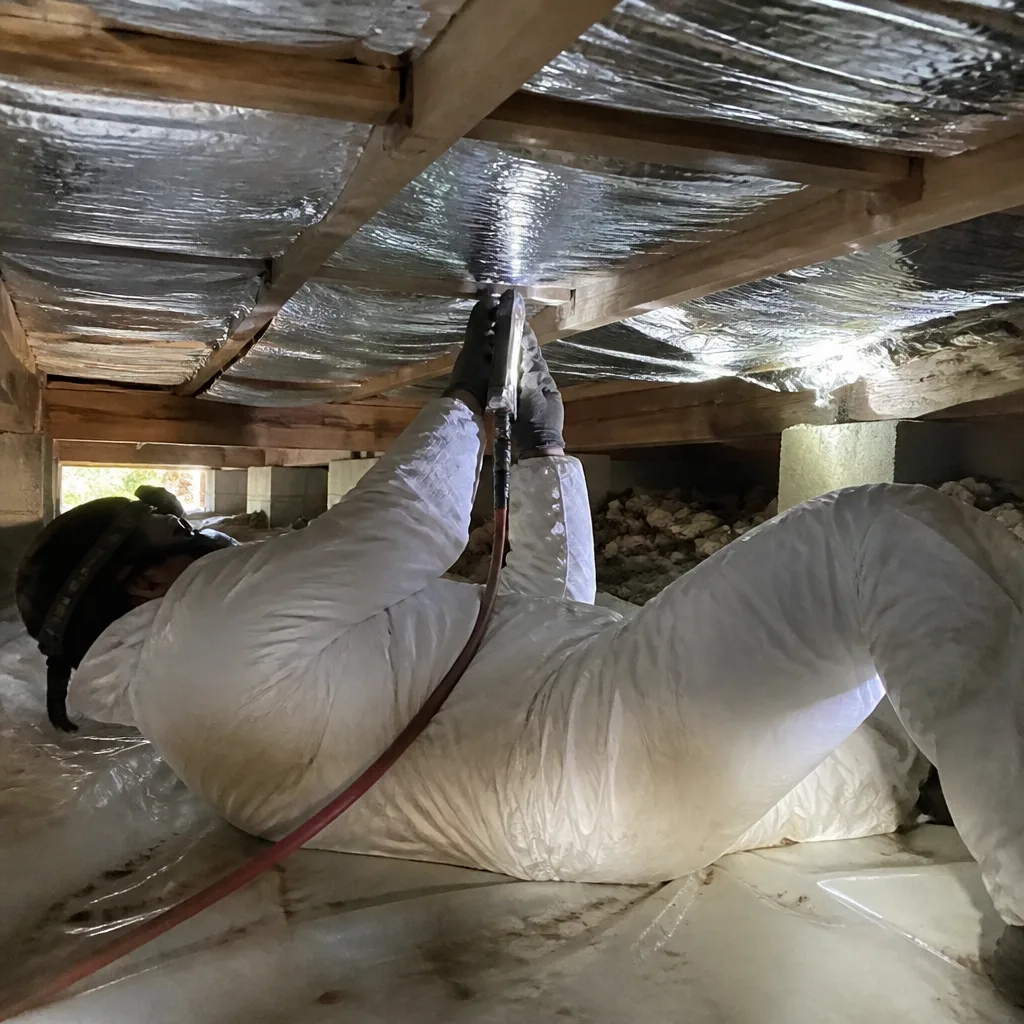
We do not drop a roll of plastic in a crawl space and call it done. The steps below reflect what actually controls moisture versus what just looks like moisture control when the inspector walks through.
- Pre-installation inspection and moisture mapping. Before any material goes in, we crawl the space with a moisture meter and a camera. We note the soil type, check for existing standing water, identify foundation vents and their condition, and photograph everything. You receive a documented photo record of the starting condition – this is standard on every visit, not available on request. We also note any existing insulation between floor joists that is hanging wet or has lost its form, because insulation installed over a moisture problem just hides the problem.
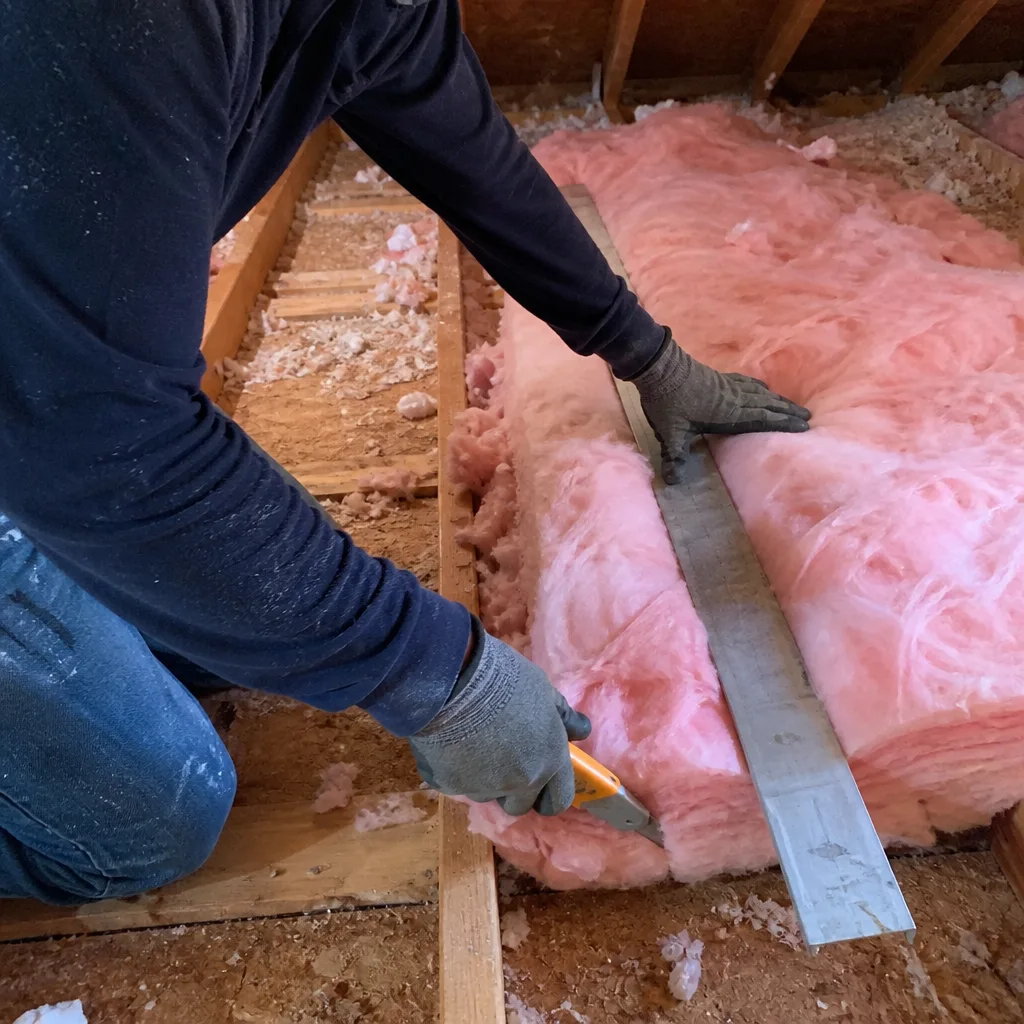
- Debris removal and subfloor preparation. Old torn vapor sheeting, construction debris, wood scraps, and deteriorated batt insulation are removed from the space. We look closely at sill plates and girder beams for soft spots, dark staining, or active mold. If we find something that needs a contractor’s attention before we proceed, we say so in writing rather than covering it up.
- Sealing penetrations and foundation wall prep. Plumbing and HVAC penetrations through the subfloor are the low-visibility spots where ground air bypasses every barrier you install. We seal these before the sheeting goes down. Vapor drive does not stop at a seam left untaped, so we treat the foundation walls as part of the moisture pathway – not as a separate step.
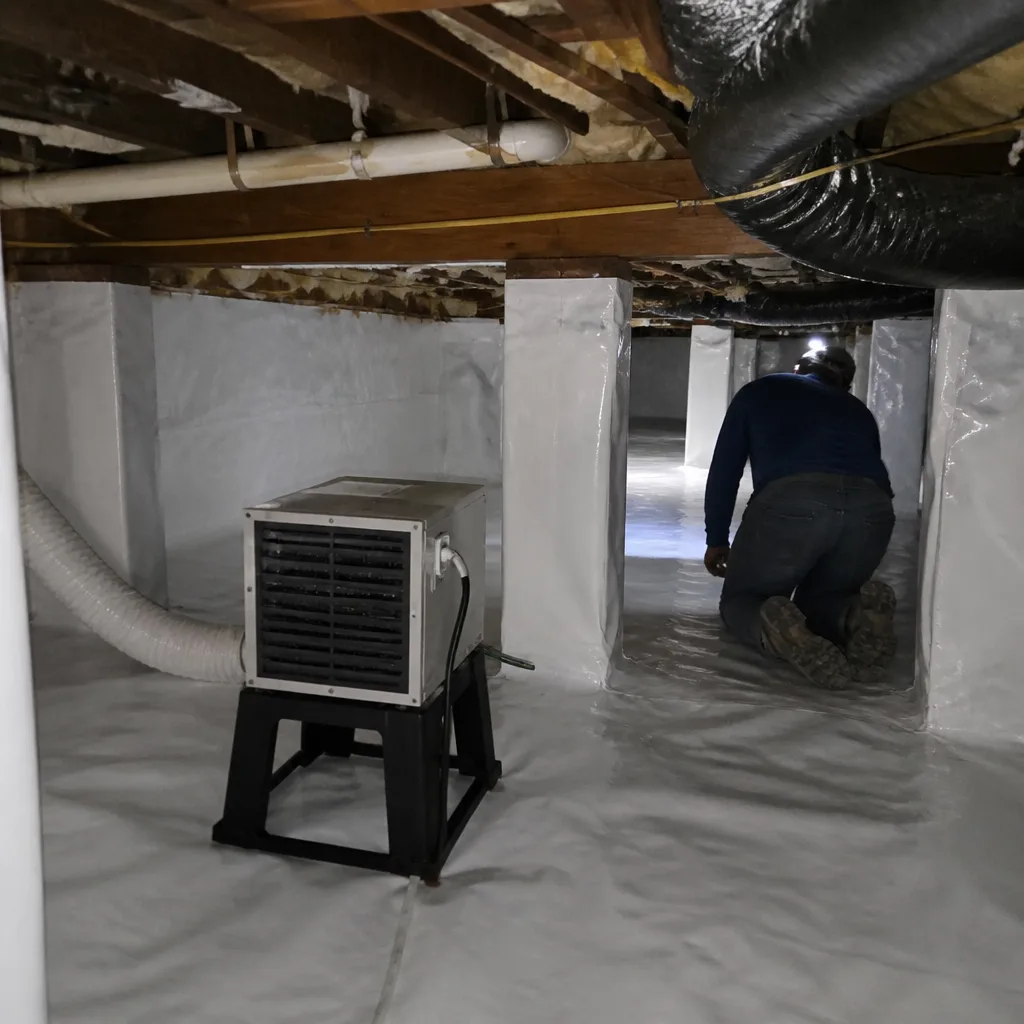
- Barrier installation – sheeting, overlaps, and tape. We use polyethylene sheeting rated for crawl space duty, sourced from manufacturers including Johns Manville and Owens Corning depending on the job specification. Mil thickness is matched to the moisture load we measured in step one – a La Puente crawl space with heavy clay soil near the Puente Hills margin gets a thicker sheet than a space over sandy fill with good drainage. Overlaps are a minimum of 12 inches and every seam is taped. The barrier runs up the foundation wall to the sill plate and is mechanically fastened, not just folded against the concrete.
- Post-installation documentation. We photograph the finished installation from multiple angles – coverage, seam taping, wall terminations, and penetration seals. Those photos become part of your documented project record, which you have in hand before we leave. On jobs where we are completing full encapsulation rather than barrier-only work, we also note airflow and humidity conditions so you have a baseline for comparison.
- Written scope and 365-Day Done Right Promise delivered at closeout. Your written warranty and job summary are provided at the end of the visit. If anything in the installation is not right within 365 days, we come back and make it right. That promise is in writing because verbal warranties don’t hold up when memories differ.
Crawl Space Vapor Barrier Pricing in La Puente
Most crawl space vapor barrier jobs we do in La Puente fall between $1,200 and $3,800 for the installed work. A smaller, clean, and accessible crawl space under a 1,200-square-foot home lands toward the low end. A larger space with existing debris, limited access height, soil-level complications, or the need for old barrier removal sits toward the high end. Below is a breakdown of what drives the number:
| Cost Factor | Typical Effect on Price |
|---|---|
| Crawl space square footage (300 sq ft vs. 1,200 sq ft) | Primary driver – roughly linear with area covered |
| Access height (under 18 inches requires specialized work) | Adds $150-$400 for low-clearance spaces |
| Existing debris or old barrier removal | Adds $200-$600 depending on volume |
| Mil thickness of sheeting (10-mil vs. 20-mil) | Thicker spec adds $100-$300 to material cost |
| Penetration sealing scope | Included in standard jobs; extensive plumbing penetrations may add $75-$200 |
| Foundation wall coverage included vs. floor-only | Wall coverage adds $200-$500 but significantly improves performance |
Every project starts with a flat written price – not a range we adjust after the crew is on site. If you have a written estimate from another contractor, we will read it with you and give you a Free Second Opinion at no charge. That is not a promotional offer; it is how we think homeowners should be able to make this decision.
To get your written price, call (626) 509-3237. A live person answers. No voicemail, no callback window measured in days.
What Makes La Puente Crawl Spaces Specific
La Puente sits at the eastern end of the San Gabriel Valley floor, where the Puente Hills form the southern boundary and the alluvial fan soils from the San Gabriel River have been built on, filled, and graded repeatedly over 80 years of residential construction. That geological reality has a direct effect on crawl space moisture behavior that generic vapor barrier guides don’t address.
Clay-heavy soils in the areas south of Valley Boulevard retain moisture for weeks after rain. During the wet months, that clay becomes essentially a reservoir sitting directly under unprotected subfloor framing. Homes in the older neighborhoods between Stimson Avenue and Francisquito Avenue were built in the 1950s and 1960s, when a single layer of 4-mil polyethylene – or nothing at all – was standard crawl space practice. That material has been degrading for decades and provides almost no functional moisture control by now.
On the northern slopes near Workman Avenue, the fill material is more variable and drainage paths can direct subsurface water toward foundation walls during heavy rain years. We have pulled old barrier material from crawl spaces in that area that had pooled water sitting on top of it – the barrier became a basin rather than a shield because it was not properly terminated and drained.
None of this is to make the problem sound worse than it is. It is to say that a vapor barrier spec written for a desert climate or a coastal climate does not automatically transfer to La Puente’s specific soil conditions and rain patterns, and we account for that in how we specify the installation.
Vapor Barrier vs. Full Encapsulation: What’s the Difference
A vapor barrier is the ground sheeting and wall termination that stops soil moisture from entering the crawl space air. Full Crawl Space Encapsulation & Vapor Barrier services add sealed foundation vents, a conditioned air supply or dehumidifier to actively control humidity in the crawl space, and in some cases spray foam at the rim joist. The vapor barrier is the core of both approaches – encapsulation builds on top of it.
Whether you need barrier-only or full encapsulation depends on your crawl space’s current humidity levels, ventilation setup, and the moisture load the space sees seasonally. We assess this at the inspection and give you a written recommendation. We are not going to tell a La Puente homeowner with a moderately damp, well-vented crawl space that they need a $12,000 full encapsulation when a $1,800 barrier installation solves the documented problem.
For homes where the inspection shows the crawl space needs more than a barrier, our full Crawl Space Encapsulation & Vapor Barrier in La Puente service covers every component of the treatment.
Key Takeaways
- Crawl space vapor barrier installation in La Puente typically runs $1,200 to $3,800 installed, with the final number depending on square footage, access conditions, and existing debris.
- La Puente’s clay-heavy soils and concentrated winter rain events create moisture loads that older 4-mil poly sheeting – or bare dirt – cannot manage.
- Every job at Topside Attic Insulation La Puente starts with a written price and ends with a documented photo record and written warranty, before and at the end of the visit respectively.
- A vapor barrier is the foundation of full encapsulation; if the inspection shows the crawl space needs more, we’ll tell you that in writing before any work starts.
- The 365-Day Done Right Promise covers all completed work. If it’s not right, we come back.
FAQs – Crawl Space Vapor Barrier
How much does a crawl space vapor barrier cost in La Puente?
Most vapor barrier installations in La Puente run between $1,200 and $3,800 for the complete installed job, including material, seam taping, penetration sealing, and wall termination. The main variables are the square footage of the crawl space, whether the access height is restricted, and whether old barrier material or debris needs to come out first. You get a flat written price before any work starts – call (626) 509-3237 to schedule an inspection and written estimate.
What mil thickness vapor barrier does a La Puente crawl space need?
10-mil sheeting meets minimum code in most La Puente applications, but we regularly specify 12-mil to 20-mil for crawl spaces over clay-heavy soil or in areas with documented seasonal moisture. The Puente Hills foothills and low-lying areas south of Valley Boulevard often warrant the heavier spec. Mil thickness is determined by the moisture reading at inspection, not by what is cheapest or easiest to install. We source sheeting from manufacturers including Johns Manville and Owens Corning, matched to the job’s documented conditions.
How long does a crawl space vapor barrier last?
A properly installed heavy-duty polyethylene barrier – mechanically fastened, fully taped at seams, and terminated at the foundation wall – typically holds its integrity for 15 to 25 years. The old 4-mil sheeting common in La Puente homes built in the 1950s and 1960s degrades significantly faster and often fails within 10 years. The most common failure points are untaped seams, barriers that were left loose on the soil floor rather than fastened, and corners left open at the foundation wall – all of which we address in our installation process.
Can a vapor barrier be installed without removing old insulation from the floor joists?
It depends on the condition of the existing Crawl Space Insulation. Batt insulation that has absorbed moisture, dropped from its hangers, or shows mold needs to come out before the barrier goes in – covering wet insulation with new sheeting traps the problem rather than solving it. Insulation that is dry, intact, and in its original position does not necessarily need to be removed for a floor-level barrier installation. We assess this at the pre-installation inspection and document what we find. If removal is needed, we include that scope in your written price before the crew starts.
Schedule Your Crawl Space Vapor Barrier Estimate
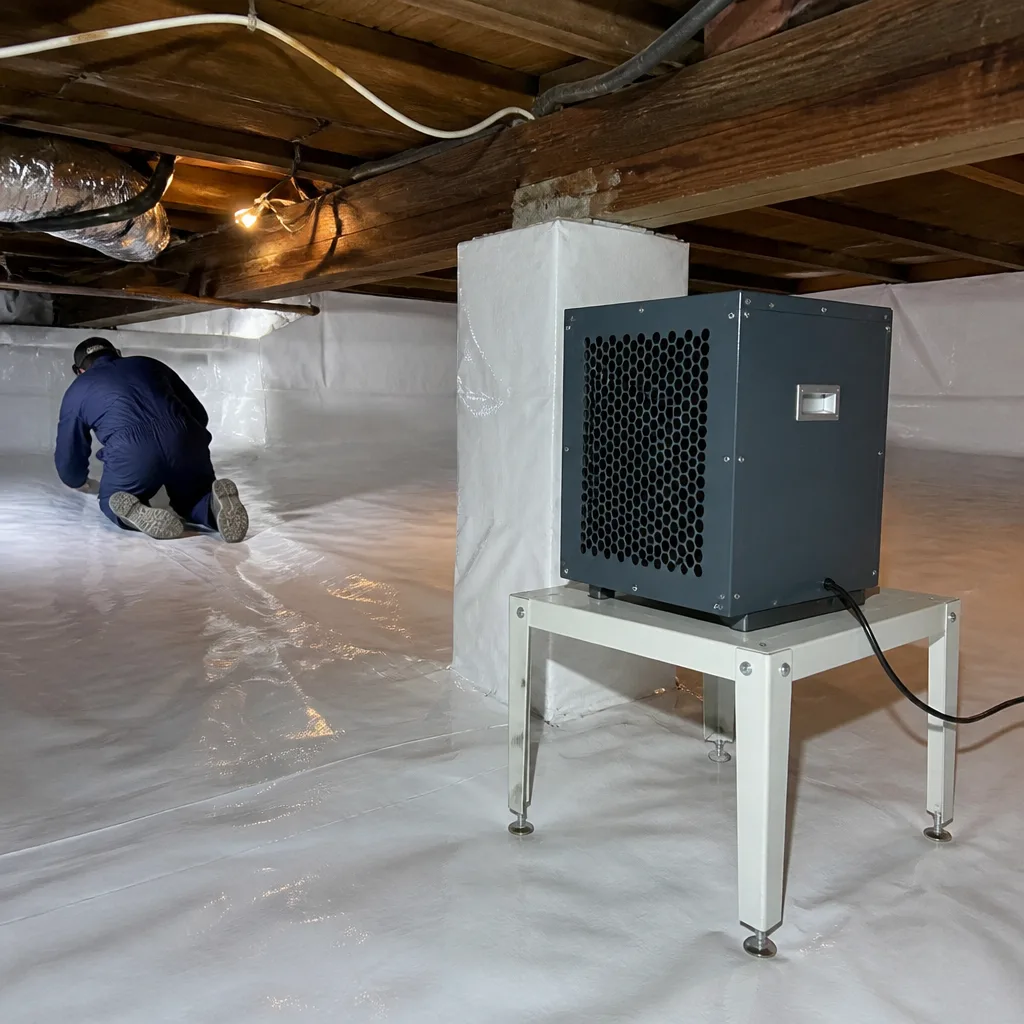
If your La Puente home has a crawl space that hasn’t been inspected in the last several years – or if you’ve noticed any of the symptoms described on this page – the inspection is the right starting point. Wes Okafor and the Topside Attic Insulation La Puente team will inspect the space, document what we find, and give you a flat written price for the work it actually needs. No vague estimates, no adjustments after the crew arrives.
Call (626) 509-3237 to schedule. A live person answers every call, including weekends. Estimates are free, written, and yours to keep whether you book with us or not.
You can also learn more about our full building-envelope services on our home page, where the complete service line is outlined alongside the Haven Standard commitments that govern every job we do.
Written by Wes Okafor, Owner at Topside Attic Insulation La Puente, serving La Puente since 2016.